Guide hosts corporate meetings in hotel conference facilities and business parks. Local community groups organise functions in civic halls and sports clubs. Hospitality teams manage events at local race courses and exhibition centres. These diverse events demand reliable crockery supplies. Event managers plan menus around specific plate and bowl sizes, ensuring a professional presentation.
Expo Hire shows live stock levels for all crockery. We deliver dinner plates, side plates, bowls, and serving dishes seven days a week, including Sundays. Event teams consolidate their orders with one supplier. This reduces logistical complexity and delivery costs for any Guide event.
Caterers select dinner plates for main courses and side plates for starters or desserts. Bowls serve soups, salads, or pasta dishes. Serving dishes present buffets and shared platters. Expo Hire stocks the right sizes for diverse menus and event styles across Guide.
Plate sizes are measured across the rim. The numbers below are standard industry sizes, though individual manufacturers vary by a centimetre or two.
| Plate type | Typical diameter | Use |
|---|---|---|
| Dinner plate | 27 to 28cm | Main course |
| Side plate | 19 to 20cm | Starter, dessert, bread |
| Soup bowl | 21 to 23cm | Soup, pasta, risotto |
| Dessert bowl | 15 to 17cm | Pudding, fruit, cereal |
| Cup and saucer | 20cl cup | Tea, Americano, espresso |
For a formal three-course dinner, each cover needs a dinner plate, a side plate, and either a soup bowl or a starter plate depending on the menu. Consult the caterer before ordering. A side plate used for a starter is a different spec decision from a purpose-built coupe soup bowl.
Order to your confirmed guest count, then add 10%. Crockery breaks, chips on edges during stacking, and late changes to the guest list happen on every large event. A buffer of 10% costs very little and prevents a shortfall becoming a service failure.
For events with multiple sittings, calculate per sitting. A 200-cover gala dinner in one sitting needs 200 dinner plates. A 200-cover event running two sittings of 100 may need only 110 to 120 plates if turnaround allows washing in between, though most operators hire full quantities to remove that dependency.
Buffet guests return for multiple servings. Allocate 2 to 2.5 plates per guest for a hot buffet with a starter and main. A simple cold buffet uses closer to 1.5 plates per guest. Bowls are needed if any hot dish is served in sauce or if dessert is a pudding or mousse.
Tea and coffee service at the end of a buffet adds cups, saucers, and teaspoons. Order one cup and saucer per guest as a minimum. Add 20% if refills are part of the service.
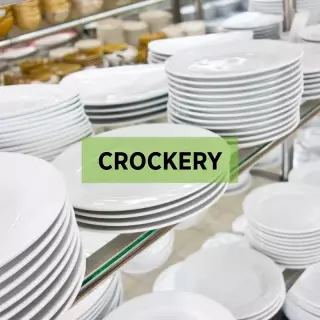
Expo Hire supplies white vitrified crockery. Vitrified means the clay has been fired at high temperature until the surface fuses into a near-glass finish. It resists chipping and staining better than standard earthenware, which is why commercial caterers use it. The white finish is neutral across all linen colours, centrepiece arrangements, and room schemes.
Crockery arrives in stackable crates. Stack plates face-down with the provided dividers to prevent surface contact. Do not exceed the recommended stack height printed on the crate. Overloaded crates are the main cause of edge chips on site. Brief catering staff on correct stacking before service ends.
All crockery comes back unwashed. Scrape food waste before stacking, but rinsing is not required. Keep crockery separate from glassware and cutlery in the return crates. The Free Minor Damage Waiver covers normal breakage on every order.
Crockery is delivered to venue across England and Wales, Monday to Sunday. For weekend events, Sunday collection removes the cost of storing equipment at the venue for an extra day.
Browse the full range on the crockery hire page, or use live chat if you need help building a quantity list from a menu.
For more information, read our Crockery Hire Guide.
"We are local to your Aston warehouse so being able to collect from you would be easier for us at least!"
"We were very pleased with Expohire's products and service. In our experience, its a reliable and efficient company and we would certainly use it again."
Read more genuine customer reviews →
Yes. Expo Hire delivers to Guide from the nearest regional depot. Enter your venue postcode at checkout to confirm delivery coverage and see the exact carriage cost before placing your order.
Yes. Expo Hire is the only event hire company in the UK that delivers and collects on Sundays. Morning and afternoon windows are available 7 days a week, 365 days a year.
Orders placed by midday on a working day can often be delivered the next day, subject to stock and route availability. For urgent requirements, call 0800 910 1100 — the team will check what is possible from the nearest depot.
The minimum order value ranges from £100 to £3,000 ex-VAT excluding carriage, depending on your delivery location.