Every large event throws up the same question. Is it cheaper to buy the chairs, tables or glassware outright, or hire them for the day? The answer depends on how often you run the event, where you would store the stock and how much variation you need from one job to the next.
Headline purchase prices can make buying look cheap. The real cost sits behind them in storage, transport, cleaning, breakage and the fact that one event rarely looks the same as the next. This guide sets the comparison out in working terms so you can see where hire wins and where ownership can still make sense.
Buying starts with the visible price, but it does not stop there. Take 100 chairs as a simple example. Add the purchase price. Add the delivery to your site. Add storage space at roughly £5 to £10 per square metre per month across the year. Add depreciation as the finish wears and styles date. Add insurance and the cost of cleaning, repairs and staff time every time the stock moves.
That stack of costs matters most when you run only two or three events per year. The stock spends most of its life idle while you keep paying to hold it. Hire converts that fixed cost into an event cost. You pay when the event happens, not every month in between.
The same logic applies to tables, glassware and catering equipment. Buying a hot cupboard or a stock of banquet glasses can look sensible on one spreadsheet row. Then you need safe storage, transport, washing and someone to manage the stock every time it leaves the building.
Buying can make sense if you run the same event ten or more times each year in the same venue with a dedicated storage facility. It also helps if the event setup does not change. If you use the same 100 chairs, the same tables and the same floor plan each time, ownership becomes easier to control.
Buying also suits venues with permanent staff who can clean, stack, move and maintain the stock as part of their normal week. In that case the labour cost is present already, so the extra burden of ownership falls.
The key word is consistency. Once the event style, quantities or venues start changing, the logic for buying weakens fast.
Hiring makes sense for organisers who run between one and nine events each year, for venues without permanent storage and for teams whose event sizes move up and down. It also makes sense when the style changes. One month may need Chiavari chairs for a wedding. The next may need conference chairs and trestle tables for a seminar. Ownership locks you into one set of stock.
Hire also works when you want one supplier to cover chairs, tables, linen, glassware and catering equipment in the same run. That reduces transport coordination and gives you one order to manage. If the guest count changes inside the final week, you can scale the order rather than buying a second batch of stock that may never earn its keep again.
Short-run events, pop-up venues, marquees and one-off dinners almost always lean towards hire once you price the real storage and handling burden.
Hire-grade furniture is commercial stock. It is built to move, stack and work through repeated event use. Buying a consumer equivalent at a similar per-unit price often means weaker joints, softer finishes and a shorter working life. That matters on chairs, where the difference between a hire-grade frame and a cheap import shows up fast under live loads.
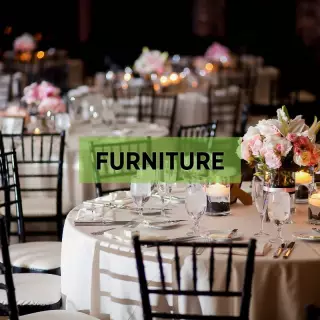
Chiavari chairs are a good example. A hire-grade aluminium Chiavari has the strength and finish needed for transport, stacking and repeated setup. A cheap domestic version can look close in a photo and fail under repeated handling. Tables, bar units and catering equipment follow the same pattern.
Ownership only wins on quality if you buy commercial stock and commit to maintaining it. Once you do that, the price gap between buying and hiring narrows.
Hire gives you room to scale up or down with short notice. It also lets you change the style to fit the job. You can take banqueting chairs for a gala, folding chairs for an outdoor ceremony and conference chairs for a seminar without building three stock rooms of your own.
That flexibility matters more than the per-unit hire price on many events. The value sits in being able to order the right product for the date, the venue and the guest count. Buying fixes you into one look and one quantity. If the event moves or the brief changes, the stock does not change with it.
Hire also makes it easier to keep matching items together. You can add glassware hire, linen hire and catering equipment hire to the same order instead of sourcing separate owned stocks across multiple categories.
Storage costs look small until you count the floor area properly. One hundred folding chairs stacked can take about 4m by 1m by 2m floor to ceiling. One hundred Chiavari chairs need more cubic space and more careful handling. Tables add more bulk, and catering equipment needs cleaner, more controlled storage than furniture.
Storage also needs transport access. It is no use owning the stock if you cannot get it from your store to the venue without hiring vans, lifts and labour. The movement cost belongs in the buying calculation as much as the storage cost does.
Most one-off event organisers do not need a furniture warehouse. They need the room to be right on the day. Hire lets you buy that outcome without carrying the stock for the rest of the year.
The figures below use a 100-person annual dinner as a planning model. They are not a quote. They show how storage and handling shift the picture as event frequency rises.
| Scenario | Hire route | Buy and store route | Comment |
|---|---|---|---|
| Once per year | Pay one event hire cost | Pay purchase, storage, cleaning and idle time for 12 months | Hire usually wins by a wide margin |
| Twice per year | Two hire spends, no holding cost between dates | Ownership still carries storage and maintenance all year | Hire often still wins |
| Five times per year | Higher annual hire spend but full flexibility | Buying starts to look stronger if the setup never changes | Decision depends on storage and labour |
The break-even point moves with every variable: venue count, storage rent, transport method, staff labour and how often the design changes. That is why two organisers with the same guest count can reach different answers.
Hire gives you things ownership cannot: Sunday delivery and collection, guaranteed stock levels before payment, no damage deposit, Free Minor Damage Waiver and live order tracking. Those extras remove admin and risk from the event plan. They also free your team from storing, cleaning and insuring the stock between dates.
If your event changes shape after the first quote, you can adjust the order rather than carry the cost of spare stock you bought for a one-off peak. That makes hire strong on weddings, awards dinners, conferences, exhibitions and any calendar with uneven event sizes.
For most organisers, the question is not "Can I own it?" The question is "Do I want to manage it when the event is over?" In many cases, hire gives the cleaner answer.
Expo Hire focuses on hire, but ask if you need a sale alternative. Some organisers also use sister brand Expo Direct for outright purchases.
Contact Expo Hire before the collection date if possible. The team can check whether an extension is available and quote any extra hire period.
Value depends on route, postcode and event scale, but many small and medium events still benefit from hire once storage and cleaning are taken into account.
Ask for a tailored quotation if you need equipment over a longer period. Longer hires are often priced differently from single-event jobs.
"Overall very happy. However disappointment when i came to know i was 5 plates short on delivery."
"Quality products delivered by friendly staff."
Read more genuine customer reviews →
For current stock and pricing, see our furniture hire page.