Schools, colleges and universities need exam furniture that meets JCQ spacing regulations, delivers before 7am and collects the same day the exams finish. This guide covers desk sizes, spacing calculations, invigilator tables and ordering lead times for the exam season.
Schools, colleges and universities need exam furniture that meets JCQ spacing regulations, delivers before 7am and collects the same day the exams finish. This guide covers desk sizes, spacing calculations, invigilator tables and ordering lead times for the exam season.
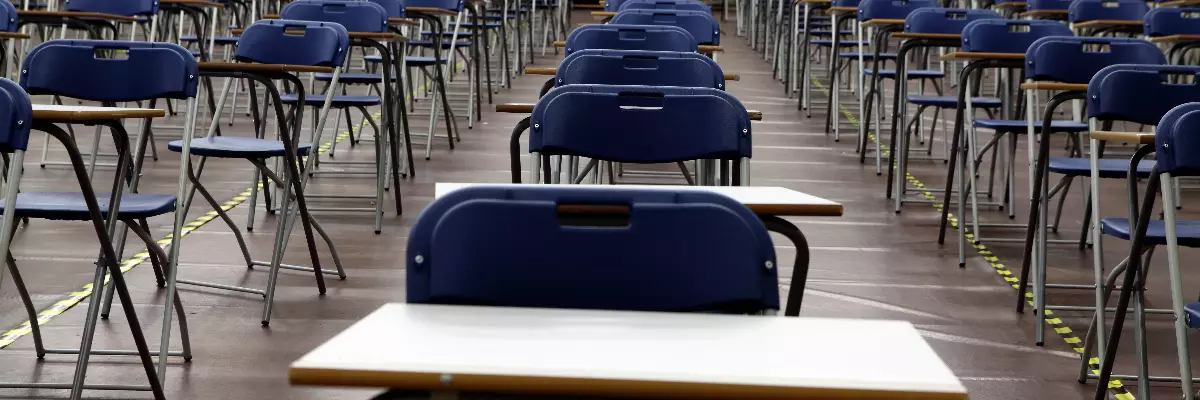
Joint Council for Qualifications regulations require exam desks to sit at 1.25 metres centre-to-centre in both directions: between rows and between desks in the same row. A standard sports hall or assembly room holds fewer desks than it appears when this spacing is applied. Measure the room and calculate capacity before placing an order.
For a 20m x 15m room, subtract 2 metres around the perimeter for walkways and the invigilator's route. The usable area of 16m x 11m gives a grid of roughly 12 columns and 8 rows at 1.25m spacing, which is 96 desks. Apply this method to your own room dimensions to get an accurate figure before confirming the order.
Standard exam desks come in two sizes: 600x450mm and 750x450mm. The 750mm width is more comfortable for A-level candidates writing extended answers or working with multiple materials alongside their paper. Both sizes fold flat for stacking and transport. Where candidates write extended essays or need a calculator, ruler and text all on the desk at once, the 750mm desk reduces cramping and improves conditions.
Order desks equal to the number of candidates plus 5 percent as reserve for late additions and replacements. For 200 candidates, order 210 desks. Seating follows the same rule: chairs equal to desks plus 5 percent. Folding exam chairs stack in sets of ten and carry without a trolley.
An invigilator table at the front of the room needs to sit clear of the candidate rows. A 4ft or 6ft folding table gives the invigilator space for papers, registers and materials. Add two chairs for senior and junior invigilators.
Request delivery before 7am when the exam starts at 9am. This gives invigilators two hours to lay out papers and check the room configuration before candidates arrive. Evening-before delivery is the alternative if the room is free; confirm venue access with the site manager first.
Noise during setup affects classrooms nearby. Folding tables and chairs moved on trolleys are quieter than steel-legged furniture dragged across hard floors. Ask the driver to bring trolleys if the exam hall sits in a teaching building where classes run until late afternoon.
Collection the same day as the final paper is possible in most cases. Give the hire depot your exam timetable so they can schedule the collection vehicle. Desks and chairs must be stacked in one area of the room for a fast collection. A room of 200 desks takes one person 20 to 30 minutes to stack if done row by row.
One depot can serve two or three schools on the same day when delivery times are staggered. If your school shares an exam season with nearby institutions, book four to six weeks ahead. Late May and mid-June are peak periods for A-level and GCSE exam furniture hire. Orders placed in March and April get first-choice delivery slots.
See the exam furniture hire page for standard packages, or browse the office and event furniture range for desks, chairs and invigilator tables.
For a 200-candidate exam hall, allow 1.25 square metres per candidate (JCQ minimum). A sports hall measuring 30 x 20 metres accommodates 480 desks at standard spacing. Calculate rows first, then confirm aisle widths meet fire exit requirements — typically 1.2 metres minimum for exit routes. The invigilator needs a clear line of sight down every row.
Exam desks and chairs need to be in position before candidates arrive. For a morning exam starting at 9am, plan for delivery and setup completion by 8am. Expo Hire offers early morning delivery slots for exam setups. For large orders, delivery the evening before the exam removes time pressure on the morning.
After the exam, desks and chairs can be collected the same day or the following morning. Stack chairs and fold desks flat for collection — Expo Hire collects everything in the delivery vehicle without additional packing.
Choose from our vast range of catering hire, furniture hire and exhibition hire products. Select from the categories listed below or use our great search function above.