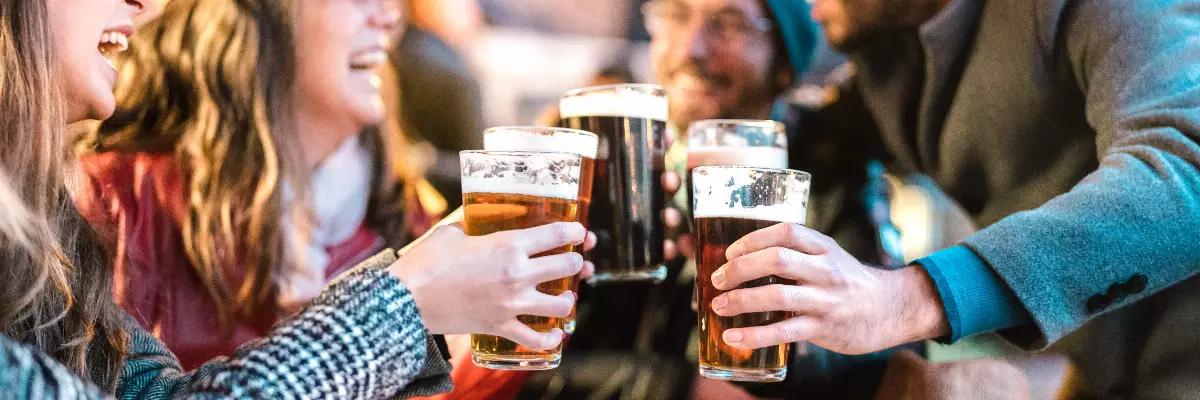
At a beer festival, the number of glasses you need is driven by throughput rather than headcount. This guide covers glass types, quantities, glass washing logistics and planning for spirits and cider alongside beer.
At a beer festival, the number of glasses you need is driven by throughput rather than headcount. This guide covers glass types, quantities, glass washing logistics and planning for spirits and cider alongside beer.
Beer festival glassware works to a different rhythm from a dinner or wedding. At a seated meal, you count covers and set the tables. At a beer festival, the pressure sits in the peaks. Guests move between bars, put glasses down, pick up fresh pours, and create a flow that depends on washing speed as much as stock depth. If the glass plan misses that pattern, the bar queue grows and clean stock disappears long before the session ends.
The standard beer festival glass is a straight pint glass, either branded or plain, or a nonik pint with the familiar bulge below the rim. Both hold a full pint and suit general service across a busy bar. If the festival includes tasting sessions or smaller measures, half-pint glasses need to sit beside the pint stock from the start. Straight half-pint glasses keep the look consistent and stack well for transport and bar setup.
A bar team can work faster when the service glass stays uniform across the main offer. That helps when crates move from storage to service and back to washing through the day. Our beer glass hire range includes standard pint and half-pint options in plain glass, which gives organisers a simple way to build the core order around one style.
A beer festival with 500 attendees over a six-hour session does not need 500 glasses. It needs enough glasses to serve the busiest part of the event while the wash station cycles used stock back into the bar. At a busy session, guests may drink four to six times over the event, and a third to a half of those drinks can fall into the second or third hour when the bars are at full pace.
That is why the quantity calculation sits on throughput rather than simple headcount. For a festival where guests collect fresh glasses through the session, 1.5 glasses per attendee gives a working base, then 25% goes on top for breakages and the wash buffer. For 500 attendees, that produces 750 base glasses plus 190 extra, which rounds to 950. If the wash setup is weak, delayed, or absent, the order needs to rise to two glasses per head as a minimum because the bar cannot rely on clean stock returning fast enough.
Some festivals use a single-glass model where guests keep the same vessel for the whole session. That changes the pressure point. In that setup, 1.2 glasses per attendee covers lost and broken glasses while keeping a reserve behind the bar for replacements. The event still needs staff who can hand out those replacements at once when a glass drops or disappears.
Washing capacity decides whether a medium glass order works like a large one. A commercial glass washer on a two-minute cycle can clean 250 to 300 glasses per hour. If the festival serves 1,000 drinks per hour at the peak, one glass washer cannot keep up. Two machines running at the same time can handle up to 600 glasses per hour, which still leaves a gap if the service rate climbs much higher.
That gap is where organisers often feel pressure. The bar team sees empty racks. Dirty glass builds up in one corner. Staff start carrying crates further than planned. The issue is not only the number of glasses on site. It is the distance and delay between dirty return, washing, and clean restock.
Position matters here. The glass wash works best when it sits close to the return point and close to the clean glass storage area. A long walk from the bar to the washer, or from the washer back to the clean racks, cuts the effective output even if the machine cycle looks strong on paper. At a large festival, the wash station is part of the bar plan, not a separate back-of-house detail.
Beer may drive the event, but many festivals serve more than pints. Tasting sessions often need half-pint service. Some events add cider, spirits, soft drinks, or mixed serves alongside the beer offer. That is where tumblers come in. A straight tumbler in the 200ml to 250ml range works for cider over ice, spirits with a mixer, and non-alcoholic drinks.
A working starting point is one tumbler per four attendees, then adjustment based on how much space the non-beer menu takes in the event. A festival built around brewing and tasting may need fewer tumblers because most guests stay with pint and half-pint glasses. A broader outdoor event with bars, soft drinks, and family groups may use more.
The advantage of ordering tumblers and pints together from the same tumbler hire and beer glass range sits in the logistics. One delivery, one return pattern, one stock point for the bar team.
Festival guests do not handle glassware like seated dinner guests. They walk with it, set it on grass banks, leave it by food stalls, and return to collect another drink before the used glass makes it back to the bar. Breakage follows that pattern. So does simple loss. The glass order needs to absorb movement through the site, not only the number of drinks poured.
That is why the buffer is not wasted stock. It is part of the service plan. A festival that aims too low on the glass count ends up using staff time to chase empties around the site. A festival that gets the count right keeps the bar focused on pouring.
The right beer festival glass order balances pint stock, half-pints, wash capacity, and a modest reserve. Once those parts line up, the bars can keep moving through the busiest hour without losing pace.
Choose from our vast range of catering hire, furniture hire and exhibition hire products. Select from the categories listed below or use our great search function above.